





 Traveler Toolkit
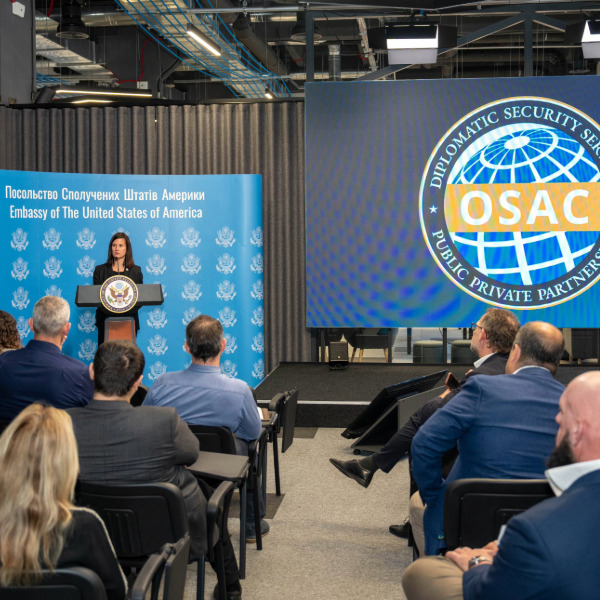

Ukraine Country Security Report
Ukraine Country Security Report
Published: April 3, 2026
This report is intended to supplement the U.S. Department of State Ukraine Travel Advisory and Ukraine International Travel Information Page.
Embassy & Consulate Contact Information
U.S. Embassy Ukraine, 4 A.I. Sikorsky St. (formerly Tankova), 04112 Kyiv, Ukraine.
+380 44 521 50 00.
Emergencies: +380 44 521 50 00.
Hours: Mon-Fri, 0800-1700.
OSAC Country Chapter
Ukraine has an active OSAC Country Chapter.
Contact OSAC’s Europe team with any questions.
Ukraine Travel Advisory
The current U.S. Department of State Travel Advisory at the date of this report’s publication recommends U.S. citizens do not travel to Ukraine due to Russia’s ongoing war against Ukraine and active armed conflict.
Review OSAC’s report, Understanding the Consular Travel Advisory System.
Crime
The U.S. Department of State has assessed Kyiv as being a MEDIUM-threat location for crime directed at or affecting official U.S. government interests.
The U.S. Department of State has not included a Crime “C” Indicator on the Travel Advisory for Ukraine.
The crime emergency line in Ukraine is 102. Review the U.S. Department of State’s Crime Victims Assistance brochure.
Crime: General Threat
Prior to Russia’s aggression in Ukraine, criminals sometimes targeted tourists due to perceived wealth. A new professional and well-trained police force (Patrol Police) has been implemented, but police corruption remains an issue. Criminal activity, including burglaries, robberies, muggings, and pickpocketing can be a problem in Ukraine. Law enforcement and emergency officials rarely speak English, and interpreters are not readily available.
Crime: Areas of Concern
Kyiv does not have designated “high-crime areas.” Criminals operate freely in more affluent neighborhoods to target homes and commit common street crimes such as pickpocketing, scams, burglaries, and vehicle break-ins. Other large cities in Ukraine mirror Kyiv regarding crime. Muggings, attacks, armed robberies, harassment, or the drugging at nightspots of unsuspecting victims – who are then robbed and/or assaulted – have been reported. Cases of assaults in apartment building corridors, elevators, and stairwells, as well as armed break-ins and crimes involving firearms, have also been reported.
Many incidents of criminal activity occur on the public transportation system, including the metro. When riding on public transportation or moving in crowded areas, keep your purse, bag, or backpack tightly under your arm and/or in front of your body.
Decentralized and flexible criminal networks are highly active in Ukraine, mainly in opportunistic crime such as drug trafficking, theft of state property, and robbery. The Russian invasion altered the structure of organized criminal groups, and some began to attempt to obtain higher status in the criminal hierarchy. There have also been reports of local criminal networks cooperating with Russian troops in order to gain more power in occupied territories.
Reports have indicated that, with a substantial stockpile of weapons, few barriers to accessing arms, and millions of small arms and light weapons on the legal and black market, Ukraine is believed to have one of the largest arms trafficking markets in Europe. While it has long been a key link in the global arms trade, Ukraine’s role intensified after the 2014 conflict in the eastern part of the country. Seizures carried out in previous years indicated that most of the arms that proliferated throughout the country were Soviet-designed models; only a small percentage comprised recently produced firearms and ammunition. The current war is expected to have an adverse effect on this market, owing to the free circulation of arms among a population who took part in the response against the whole-scale Russian invasion, as well as increased additional supplies provided by European countries and the US. While evidence of the number of arms illegally circulating throughout the country is extremely limited, there are already signs that illegal guns are playing a greater role in crimes carried out both in Ukraine and in nearby regions in Russia.
Review OSAC’s reports, All That You Should Leave Behind, Hotels: The Inns and Outs, Considerations for Hotel Security, Taking Credit, and Our Two Cents: Petty Crime Basics and How to Minimize the Risk.
Kidnapping Threat
The U.S. Department of State has not included a Kidnapping “K” Indicator on the Travel Advisory for Ukraine.
There are continued reports of Russian forces and their proxies singling out U.S. citizens in Russian-occupied areas of Ukraine for detention, interrogation, or harassment because of their nationality. U.S. citizens have also been singled out when evacuating by land through Russia-occupied territory or to Russia or Belarus.
Additionally, kidnappings and wrongful detentions of Ukrainian and other European travelers in Russian-occupied (or contested) territory have been reported. Kidnappings in these regions may be attributed to local militia forces, local police, criminal elements, or Russian military forces.
Review OSAC’s reports, Kidnapping: The Basics and Active Shooter and Kidnapping Response Tips.
Terrorism
The U.S. Department of State has assessed Kyiv as being a MEDIUM-threat location for terrorism directed at or affecting official U.S. government interests.
The U.S. Department of State has not included a Terrorism “T” Indicator on the Travel Advisory for Ukraine.
Credible information indicates that terrorist groups continue plotting possible attacks in Europe. European governments are taking action to guard against terrorist attacks; however, all European countries remain potentially vulnerable to attacks from transnational terrorist organizations.
Russian forces have been targeting civilians and civilian infrastructure, including residential buildings, schools, and hospitals, since the start of their February 2022 invasion of Ukraine. All U.S. citizens should carefully monitor U.S. government notices and local and international media outlets for information about changing security conditions and alerts to shelter in place. Those choosing to remain in Ukraine should exercise caution and consult the U.S. Department of State’s latest security alerts.
The security situation in Ukraine remains unpredictable. U.S. citizens in Ukraine should stay vigilant and take appropriate steps to increase their security awareness. Know the location of the closest shelter or protected space. In the event of mortar, missile, drone, or rocket fire, follow instructions from local authorities and seek shelter immediately. If the current location is no longer safe, carefully assess the potential risks involved in moving to a different location.
Many in the international community, including the United States and Ukraine, do not recognize Russia’s purported annexation of Crimea in 2014, nor the September 2022 purported annexation of four other Ukrainian oblasts – Donetsk, Luhansk, Kherson, and Zaporizhzhia. There is extensive Russian Federation military presence in these areas. There are also abuses against foreigners and the local population by the occupation authorities in these regions, particularly against those who are seen as challenging Russia’s occupation.
Political Violence and Civil Unrest
The U.S. Department of State has assessed Kyiv as being a CRITICAL-threat location for political violence directed at or affecting official U.S. government interests.
The U.S. Department of State has not included a Civil Unrest “U” Indicator on the Travel Advisory for Ukraine. Avoid demonstration activity, as even those planned to remain peaceful have the potential to turn violent.
Elections/Political Stability
Ukraine is a republic with a semi-presidential political system composed of three branches of government: a unicameral legislature; an executive led by a directly elected president who is head of state and commander in chief; and a prime minister, who is chosen through a legislative majority and as head of government leads the Cabinet of Ministers; and a judiciary. As of February 2022, when martial law was declared in Ukraine, all elections are postponed under Article 19 of Ukraine’s Constitution.
Protests & Demonstrations
Protests are largely nonexistent under martial law. Permits are required for protesting. When approved, they can interrupt logistics and services.
Review OSAC’s report, Surviving a Protest.
Anti-U.S./Anti-Western Sentiment
Ukraine continues to seek to strengthen its ties with the West, including the United States and the European Union, especially in the aftermath of Russia’s war in Ukraine. There are no significant instances of anti-U.S./anti-Western sentiment impacting the private sector.
Law Enforcement
The Ministry of Internal Affairs is responsible for maintaining internal security and order and oversees police and other law enforcement personnel. The Security Service of Ukraine is responsible for state security broadly defined, nonmilitary intelligence, counterintelligence, and counterterrorism matters. The Ministry of Internal Affairs reports to the Cabinet of Ministers, and the Security Service reports directly to the president.
The State Border Guard Service, which falls under the Ministry of Internal Affairs, implements state policy regarding border security, while the State Migration Service, also under the Ministry of Internal Affairs, implements state policy regarding migration, citizenship, and registration of refugees and other migrants. Civilian authorities generally maintained effective control over security forces in the territory controlled by the government. There were reports that members of the security forces committed some abuses in the context of Russia’s full-scale invasion.
Police Response
Ukrainian law enforcement agencies do not meet Western standards, and their ability to investigate criminal incidents adequately is limited. While there has been some significant progress (e.g., the Patrol Police in Kyiv), response time remains below Western standards and case resolution remains an ongoing problem. The police are often reluctant to take victim statements in cases of a minor criminal act, primarily to avoid poor crime statistics and additional work. Due to insufficient pay, law enforcement officers often lack the motivation to solve crimes.
Armed Conflict
On February 24, 2022, the president of the Russian Federation, Vladimir Putin, launched an unlawful and unprovoked full-scale invasion of Ukraine, resulting in war crimes, crimes against humanity, and other atrocities committed by members of Russia’s forces. International organizations and nongovernmental organizations, including Amnesty International, Human Rights Watch, the Organization for Security and Co-operation in Europe, and the UN Human Rights Monitoring Mission in Ukraine, issued periodic reports documenting abuses committed by Russia’s forces during the war; however, Russia’s forces and their proxies throughout the war methodically obstructed, harassed, and intimidated international monitors denying them sufficient access.
Following the start of its 2022 full-scale invasion, Russia’s forces continued to escalate attacks on civilians. Russia mobilized, armed, trained, and led proxy forces from territories under its occupation (including parts of Donetsk, Kherson, Luhansk, and Zaporizhzhya oblasts and Crimea). Through the end of the year, Russia’s forces continued to conduct hostilities, including launching missile and drone strikes throughout Ukraine, hitting critical infrastructure, including power, water, and heating facilities. The UN Office of the High Commissioner for Human Rights noted that widespread attacks by Russia’s forces against critical infrastructure during the coldest months of the year caused the humanitarian situation to further deteriorate, leading to mass displacement of civilians.
In February 2022, Ukrainian government declared a state of emergency. Each province (oblast) decides on measures to be implemented according to local conditions. Measures could include curfews, restrictions on the freedom of movement, ID verification, and increased security inspections, among other measures. Follow any oblast-specific state of emergency measures.
Serious human rights abuses committed by Russia’s forces in occupied areas involved severe and wide-ranging cases and included credible reports of:
· Mass and unlawful killings, including extrajudicial killings and forced disappearances;
· Torture and cruel, inhuman, or degrading treatment or punishment, including of children;
· Arbitrary arrest or detention as well as political prisoners or detainees, particularly during “filtration” operations involving interrogation, torture, forced separation of families, forced deportation and adoptions of Ukraine’s children to Russian families;
· Unjust interference with privacy, and punishment of family members for alleged offenses of a relative;
· Serious abuses in a conflict, including atrocities, abductions, torture and physical abuses;
· Serious restrictions on freedom of expression, including for members of the media, including violence or threats of violence against journalists, unjustified arrests or prosecutions of journalists, censorship, and the existence of criminal libel;
· Serious restrictions on internet freedom, as well as substantial interference with freedom of peaceful assembly and freedom of association, including overly restrictive “laws” on the organization, funding, or operation of nongovernmental organizations and civil society organizations;
· Severe restrictions of religious freedom and restrictions on freedom of movement;
· Inability of citizens to vote in free and fair elections as well as serious and unreasonable restrictions on political participation;
· Serious restrictions on or harassment of domestic and international human rights organizations;
· Lack of investigation of and accountability for gender-based violence;
· Crimes involving violence or threats of violence targeting members of national/racial/ethnic minority groups, or members of Indigenous groups, including Crimean Tatars and ethnic Ukrainians;
· And crimes involving violence or threats of violence targeting lesbian, gay, bisexual, transgender, queer, and intersex persons.
The Russian Federation conducted sham referenda in Donetsk, Kherson, Luhansk, and Zaporizhzhya oblasts in September 2022. President Putin proclaimed the so-called annexation of these four oblasts into the Russian Federation on September 30. On March 3 and October 12, 2022, UN General Assembly resolutions condemned both Russia’s invasion and the purported annexation of Ukrainian territories.
Transportation Security
Road Safety
Roads throughout the country are in various degrees of disrepair. Traffic in Kyiv is heavy on weekdays during commuting hours, and unexpected traffic patterns often delay travel in the city during workdays. Main thoroughfares are well illuminated and maintained, but side streets and less commonly used avenues are often poorly illuminated, narrow, and poorly maintained. Driving can be a challenge to foreigners. Local drivers routinely disregard traffic laws and engage in excessive speeding, driving the wrong way on one-way streets, driving in oncoming lanes to maneuver around blocked traffic, and driving on sidewalks. Using sidewalks for parking is common practice, often blocking pedestrian access and endangering pedestrians.
Drivers must always be alert for pedestrians crossing busy streets outside of crosswalks. In many locations, the only indication of an authorized crosswalk is a signpost, instead of markings in the street visible to drivers. Drivers must be ready to stop on short notice and drive defensively.
Highways and roads in smaller towns are not illuminated, and emergency services are not reliable or prompt. Use caution driving outside of major cities after dark. Snow removal is intermittent and unreliable, creating dangerous conditions especially along secondary roads. Subsequent snowfall and ice build-up cause considerable traffic delays, parking problems, and accidents.
Vehicle accidents are common, and even fender benders routinely tie up traffic. Drivers involved in accidents may not move their vehicles unless not doing so presents a clear safety concern. Drivers must notify police, who will then decide responsibility, take each driver’s personal information, and file an accident report. Even in Kyiv, accident evaluation can take up to two hours before vehicles can move. The introduction of the Patrol Police has reduced response times, but heavy traffic and limited resources, especially outside major cities, continues to delay the arrival of police and ambulances.
U.S. drivers licenses are not valid in Ukraine as their vehicle categories do not meet the standards enumerated in the 1968 Convention on Road Traffic (as amended in 2011). Travelers who do not have a foreign driver’s license that meets these requirements must obtain either a Ukrainian driver’s license or an International Driving Permit.
Police rarely possess English-language capability, even in units designated to combat crimes against foreign nationals. As a result, reporting a crime and following up on the status of a case is often a lengthy and challenging process.
Travelers can leave Ukraine by car through most border crossing points, but Ukraine’s border crossings with Russia and Belarus are closed to regular traffic. There could be long lines at the border crossing points with EU member states and Moldova. Have a good supply of food, water, warm clothing, medication and fuel.
The State Border Guard Service of Ukraine (SBGSU) will check the following documents: registration documents for the car and International Insurance Certificate for the vehicle (Green Card), which you can buy from Ukrainian or International Insurance companies.
Review OSAC’s reports, Road Safety Abroad, Driving Overseas: Best Practices, and Evasive Driving Techniques; and read the U.S. Department of State’s webpage on driving and road safety abroad.
Public Transportation Safety
Due to the Russian invasion of Ukraine, expect disruption to travel and transport networks. Only travel if it is safe to do so. Where possible, check if public transport is operating before traveling.
Large cities also have aboveground trolleys and small shuttle buses (marshrutkas). Buses and trolleys in Kyiv occasionally break down, but are generally safe. Many incidents of criminal activity occur on the public transport system, including the metro. When riding public transportation, keep purses, shoulder bags, and backpacks closed, in front of you, or tucked under your arm to prevent theft. It should also be noted that underground metro stations are often used as bomb shelters in major cities; this may cause crowding or delays.
Only use marked taxis. Fares are given in advance when you order a taxi by phone, but prices are typically negotiated with the driver in advance if hailing a cab in the street. Do not sit in the front seat of the taxi, enter a taxi with unknown passengers, or travel to unfamiliar areas. Buses and trams are widely used, when available.
Aviation Concerns
The Federal Aviation Administration (FAA) has issued a Notice to Air Missions (NOTAM) prohibiting U.S. aviation operations into, out of, within, or over Ukraine. For more information, U.S. citizens should consult the FAA’s Prohibitions, Restrictions, and Notices.
Review OSAC’s Report, Security in Transit: Airplanes, Public Transport, and Overnights.
Maritime Security
The ongoing Russia’s war in Ukraine presents a serious and immediate threat to the safety and security of crews and vessels operating in the region. In the Black Sea and in the Azov Sea, port infrastructure and ships have been hit by projectiles causing extensive damage. This has provided enormous obstacles for shipping since the start of the war.
After a complete halt of Ukraine maritime activities in the Black Sea, the implementation of the Black Sea Grain Initiative in early August 2022 created an export corridor for certain agricultural products and allowed for the partial resumption of shipping activities from Ukraine. The deal was terminated in July 2023 and, multiple commercial and personal vessels have been targeted by Russian drone and naval strikes in the Black Sea.
Travelers with Special Considerations
For specific traveler concerns in Ukraine, review the local laws and circumstances on the U.S. Department of State’s Country Information Page.
Rule of Law, Arbitrary Detention, Official Harassment, Corruption, & Transparency
The U.S. Department of State has not included a Risk of Wrongful Detention “D” Indicator on the Travel Advisory for Ukraine. However, The U.S. Department of State has included the Risk of Wrongful Detention “D” indicator on the Travel Advisory for Russia, and those in Russian-controlled or contested territory may be subject to detention by Russian military forces or Russia-aligned local militias and law enforcement authorities.
The law provides criminal penalties for corruption, but authorities do not always effectively implement the law, and many officials engage in corrupt practices with impunity. With Russia’s war in Ukraine, the nation’s priorities shifted to the war and martial law stifled transparency. In March 2022, the parliament suspended the requirement of asset disclosures for public officials during the period of martial law, to prevent Russia financially targeting Ukrainian leaders. The suspension undermined the system of monitoring and control over incomes, expenditures, and assets of public officials.
Anticorruption institutions have reported a hampered capacity to investigate and prosecute corruption cases due to budget cuts and a decrease in staff as personnel voluntarily mobilized to the frontlines. The Specialized Anticorruption Prosecutor’s Office reported six of its 12 lead prosecutors willingly mobilized at the onset of the war but did not have a mechanism to return. Civil society also has recognized that the public appetite for criticizing corruption has diminished as the country rallies together to support the cause of Ukraine’s fight against Russia.
While the number of reports of government corruption was low according to the National Corruption Bureau of Ukraine (NABU), observers note that corruption remains common at all levels in the executive, legislative, and judicial branches.
Corruption continues to be a significant influence on justice, the work of law enforcement institutions, the management of state property and state companies, and state regulation.
Antireform elites and oligarchs continue to pressure anticorruption bodies by using misinformation campaigns and political maneuvering to undermine public trust. Human rights groups have called for increased transparency and discussion regarding proposed changes to these bodies, particularly respecting procedures for appointments to leadership positions.
Law enforcement agencies often fail to appropriately investigate cases of attacks against journalists, human rights defenders, and activists, particularly those who focused on exposing corruption
Health Concerns
The U.S. Department of State has not included a Health “H” Indicator on the Travel Advisory for Ukraine. Review the U.S. Centers for Disease Control and Prevention’s (CDC) country-specific Travel Health Notices for current health issues that impact traveler health, like disease outbreaks, special events or gatherings, and natural disasters.
The medical emergency line in Kyiv and other major cities is 103. There may not be an English-speaking operator available. Ambulance crews do not respond quickly and do not often include trained paramedics. The general quality of healthcare in Ukraine does not meet U.S. standards. Travelers with pre-existing conditions should carefully consider whether adequate care would be available during a trip to Ukraine.
Find contact information for available medical services and available air ambulance services on the U.S. Embassy website. The U.S. Department of State strongly recommends purchasing international health insurance before traveling internationally. Review the U.S. Department of State’s webpage on health insurance overseas.
See OSAC’s Guide to U.S. Government-Assisted Evacuations; review OSAC’s reports, The Healthy Way, Shaken: The Don’ts of Alcohol Abroad, Health 101: How to Prepare for Travel, and Fire Safety Abroad; and visit the U.S. Department of State’s webpage on Your Health Abroad for more information.
Vaccinations
Review the CDC Travelers’ Health site for country-specific vaccine recommendations.
Issues Traveling with Medications
Travelers with chronic medical conditions that require medication should bring enough medicine with them, since medicine may not be readily available. You may not import narcotic pain relievers into Ukraine, even in small quantities and with a prescription.
If traveling with prescription medication, check with the State Register of Medicines (Ukrainian language only) to ensure the medication is legal to bring into the country, as many medications that are legal in the United States are prohibited in Ukraine. Always carry prescription medication in original packaging with the doctor’s prescription.
Review OSAC’s report, Traveling with Medication.
Water Quality
Tap water is not potable, but it is safe for bathing and cooking in large cities. Ukraine’s water supply and wastewater treatment systems, or the electricity systems needed to run them, have been regularly destroyed by Russian attacks.
Review OSAC’s report, I’m Drinking What in My Water?
Natural Disasters
The U.S. Department of State has not included a Natural Disaster “N” Indicator on the Travel Advisory for Ukraine.
The war has led to extensive pollution of air, water, soil and biota, exacerbated by the breach of the Kakhovka Dam, with long-term health and environmental risks. In a country with pre-war environmental problems (including poor urban air quality, poor waste management and ineffective environmental controls), the long-term effect of damage is likely to be more destructive than the immediate effects.
The disastrous flooding following the breach of the Kakhovka dam poses additional long-term health risks due to the discharge of hazardous chemicals from downstream manufacturing facilities. The floodwaters were also contaminated with biological hazards, such as untreated sewage and dead wildlife, increasing the risk of waterborne diseases such as cholera, diarrhea and others.
Avoid wild berries, wild fowl and game, and mushrooms originating from areas surrounding Chornobyl, as these retain higher than average levels of radiation. Radiation background levels vary in different areas depending on natural/geological conditions, industrial development levels, and specific industries. In Ukraine, the allowable limit for background radiation is 25 microrems per hour. Since 1987, levels exceeding that figure have not been observed in Kyiv; the average and constant numbers for Kyiv are 12-14 microrems/hour.
Cybersecurity
Even before the most recent Russian invasion, Ukrainian government officials, private-sector experts, and journalists reported that Ukraine experienced several hundred to several thousand cyberattacks against government ministries and information portals each month. These included run-of-the-mill denial-of-service attacks, which prevent users from connecting to a site or server for a limited period, to attacks that affect critical infrastructure, and attacks that deface publicly accessible information and service portals—often with a political message.
Since Russia’s war in Ukraine, Ukrainian resources and infrastructure are frequently victims of cyberattacks by state and non-state actors. In December 2023, there was a high-impact cyberattack on Ukrainian networks. Ukraine’s largest mobile network operator, Kyivstar, suffered a cyberattack which left users without a mobile signal or the ability to use the internet. It also disrupted air raid apps, some banks, ATMs, and point-of-sale terminals. In 2025, there was a 17% increase in the frequency of cyberattacks on Ukrainian government, energy, and critical infrastructure, with the Ukrainian government reporting roughly 15 cyberattacks per day targeting. Ukraine established a military “Cyber-Force” to counter these attacks and to streamline defense as a result of this increase.
There is a persistent risk that cyberattacks could disrupt mobile, internet and banking services.
Review OSAC’s reports, Cybersecurity Basics, Best Practices for Maximizing Security on Public Wi-Fi, Traveling Abroad with Mobile Devices, and Guide for Overseas Satellite Phone Usage.
Counterintelligence Issues
Exercise security precautions like using VPNs and robust antivirus software.
Import/Export Restrictions
There are no restrictions on satellite phones in Ukraine.
A country-specific listing of items/goods prohibited from being exported to the country or that are otherwise restricted is available from the U.S. International Trade Agency website.